We just refuse to call them assets.
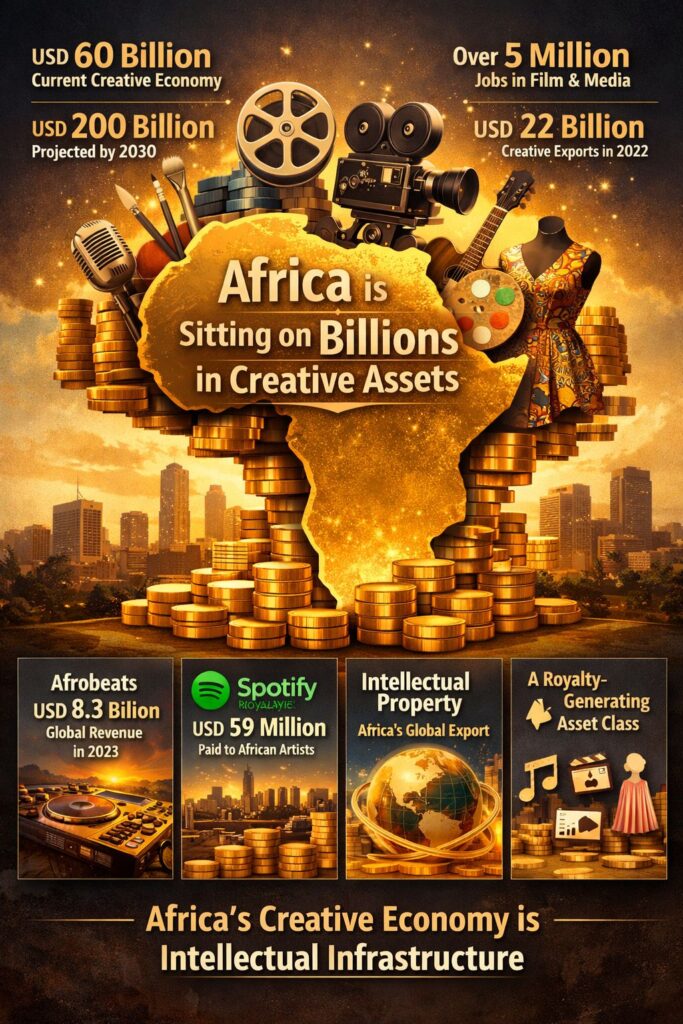
Africa’s creative industries already employ millions and generate billions in economic value. Estimates from UNCTAD and the African Development Bank value Africa’s creative economy at USD 50–65 billion annually. With enabling finance and trade conditions, the sector could expand to capture up to USD 200 billion in global export value by 2030.
The film and audiovisual sector alone employs over 5 million people and accounts for USD5 billion in GDP across the continent. Creative exports from Africa reached USD22 billion in 2022, accounting for 3% of total exports
African intellectual property is now a global export.
Afrobeats generated USD8.3 billion in global revenue in 2023. Spotify paid USD59 million in royalties to Nigerian and South African artists in 2024 driven largely by international audiences.
But the constraint in Africa’s creative economy is the right financial structures.
Traditional finance is designed for fixed assets like real estate and commodities. Creative businesses on the other hand generate value differently. They generate value through intellectual property that compounds over time.
A song is a royalty stream.
A film is a licensing asset.
A fashion brand is exportable IP.
The creative economy needs to be understood as Africa’s most scalable form of intellectual infrastructure.
Africa’s creative economy is a royalty-generating asset class.
In the decades ahead, Africa will not only export commodities but also creative assets at scale.
Great content! Keep up the good work!